
24/30 Grooming Hides in Plain Sight: It Doesn't Look Like Out of Place
Nothing about it photographs correctly.
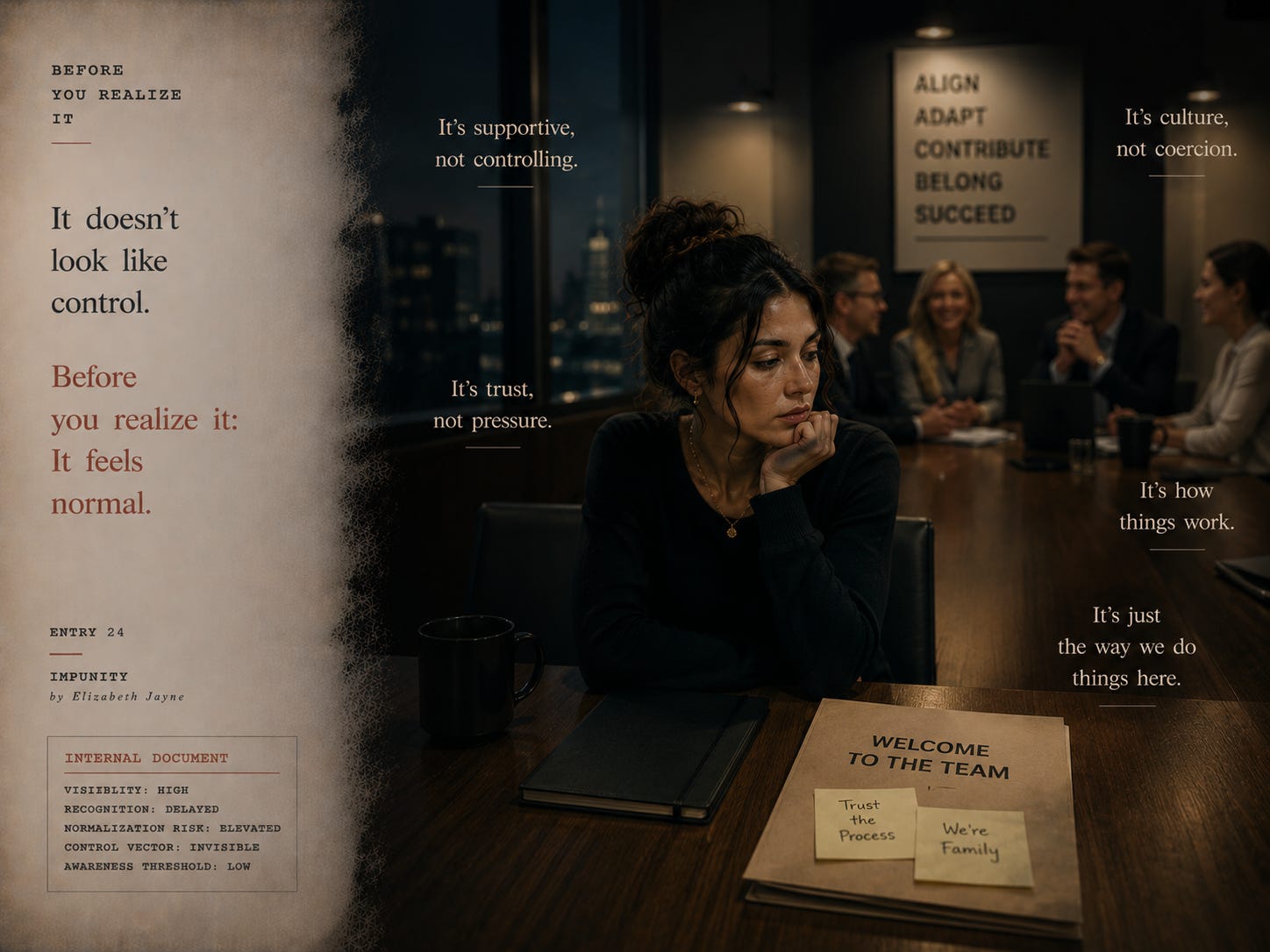
Nothing about it looks alarming at first.
That’s part of why it works.
The conversations sound thoughtful.
The environment feels organized.
People speak carefully.
Everyone seems emotionally aware of one another.
There are rules about respect.
Rules about professionalism.
Rules about safety.
Rules about tone.
The structure presents itself as thoughtful enough that you stop looking for the pressure inside it.
You stop expecting pressure to exist at all.
That shift happens quietly.
A comment lands wrong for a second.
Someone smooths it over before the silence fully settles.
A boundary moves slightly.
Nobody reacts strongly enough for you to trust your own reaction to it.
An interaction leaves you uneasy.
By the next morning, everyone is behaving as though it made perfect sense.
You adjust faster than you realize.
Does this resonate? Leave a comment.
I read every one. Even the short ones. Especially the short ones.
Most people do.
Especially in environments tied to belonging.
Creative circles.
Political spaces.
Religious institutions.
Residencies.
Luxury environments built around access.
Places where proximity itself starts feeling valuable.
The atmosphere matters there.
The social rhythm matters.
You learn very quickly which reactions keep things smooth and which reactions change the temperature in the space.
And after a while, you stop experiencing the adaptation as adaptation.
It feels mature.
Professional.
Reasonable.
You tell yourself:
Maybe this is just how these environments function.
Maybe everyone here understands something I don’t yet.
Maybe discomfort is part of growth.
Maybe I’m still adjusting.
Nothing inside the system feels dramatic enough to justify interruption.
That’s what makes it dangerous.
Because grooming often survives through normalization long before it survives through fear.
People continue showing up.
Still laughing.
Still participating.
Still defending the environment publicly.
Still posting photographs from inside it.
The structure keeps moving because nobody inside it fully experiences themselves as trapped.
Not yet.
By this stage, the pressure has already blended into routine.
The language sounds normal.
The behavior sounds normal.
The imbalance sounds normal.
And once something feels normal long enough, people stop examining it closely.
They start living inside it automatically.