
16/30 How Grooming Rewrites What Feels Normal Until You Stop Questioning It
You don’t remember deciding to change.
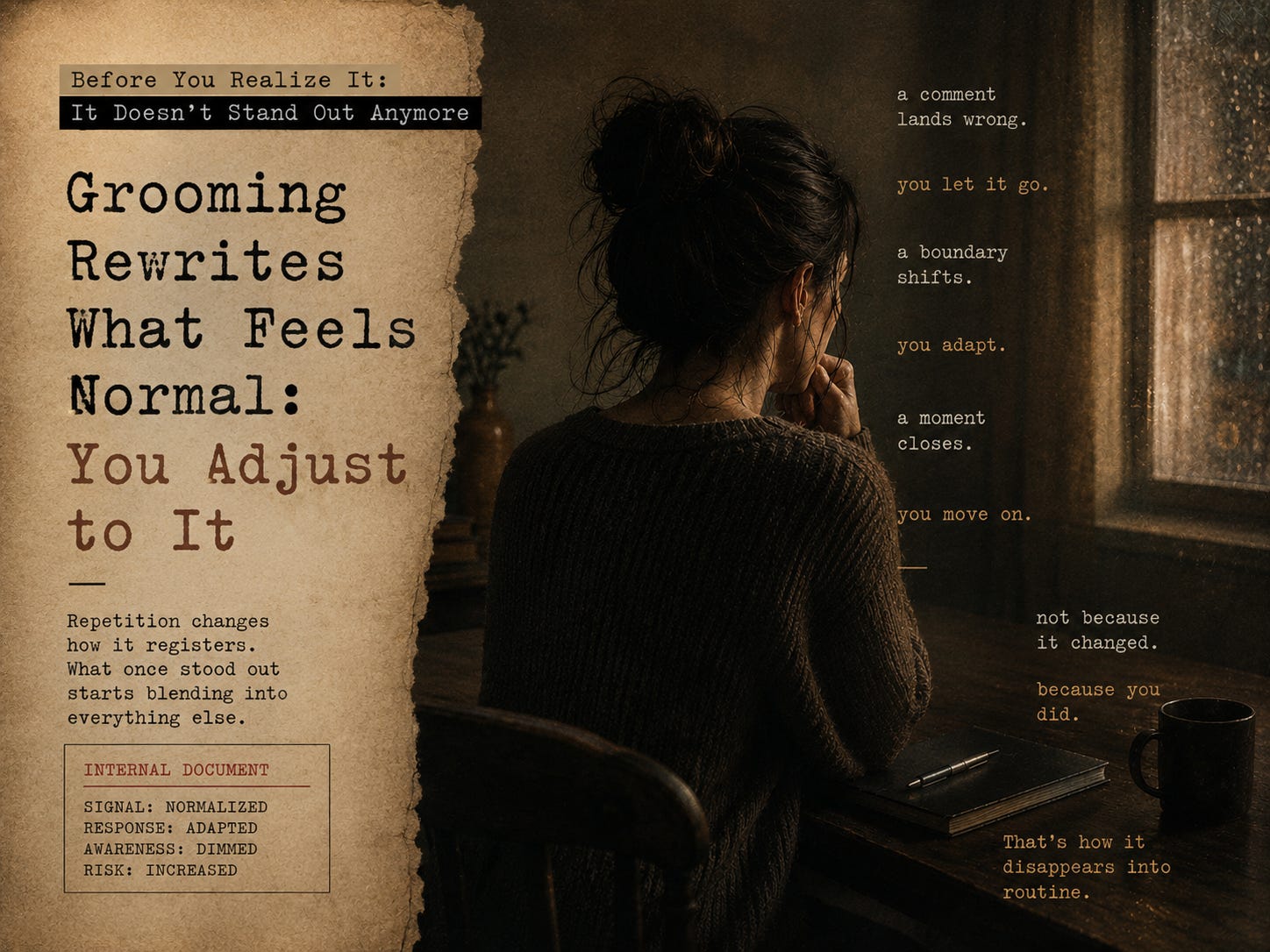
This is where grooming starts disappearing into routine.
Not because it stops.
Because your reactions stop catching on it the same way.
At first, certain things stayed with you.
A pause that lasted too long.
A joke that pressed slightly harder than it needed to.
The feeling that a line had shifted while everyone else kept moving.
Now the moments pass faster.
Someone says something that would have bothered you before.
The conversation keeps moving.
You keep moving with it.
A hand stays on your shoulder a second longer than necessary.
You barely register it by the time it’s gone.
You already know which reactions change the air.
Which ones make things awkward.
Which ones make people look at you differently.
So your body adjusts first.
You smile sooner.
You let things slide faster.
You answer in the version that keeps the moment clean.
Not because you decided to.
Because repetition teaches the rhythm before you notice you’ve learned it.
Does this resonate? Leave a comment.
I read every one. Even the short ones. Especially the short ones.
That’s how grooming survives.
Not through constant pressure.
Through adaptation.
The things that once interrupted you
start blending into everything around them.
You stop separating certain moments from the rest of the day.
They stop feeling distinct enough to hold onto.
Expected.
Routine.
Part of how things work here.
And once something feels normal,
your mind stops lifting it into focus.
You don’t pause on it long enough to compare it to who you used to be.
A comment lands wrong.
Someone laughs.
You laugh too.
The moment closes before your discomfort fully reaches the surface.
That starts happening more often.
Not because nothing feels off anymore.
Because the feeling fades faster now.
You’ve already learned how to move past it before it settles.
And when it happens again,
your body barely pauses long enough
to call it different.