
28/30 How Grooming Changes What Feels Possible for Your Future and Identity
Your world gets smaller in careful, reasonable ways.
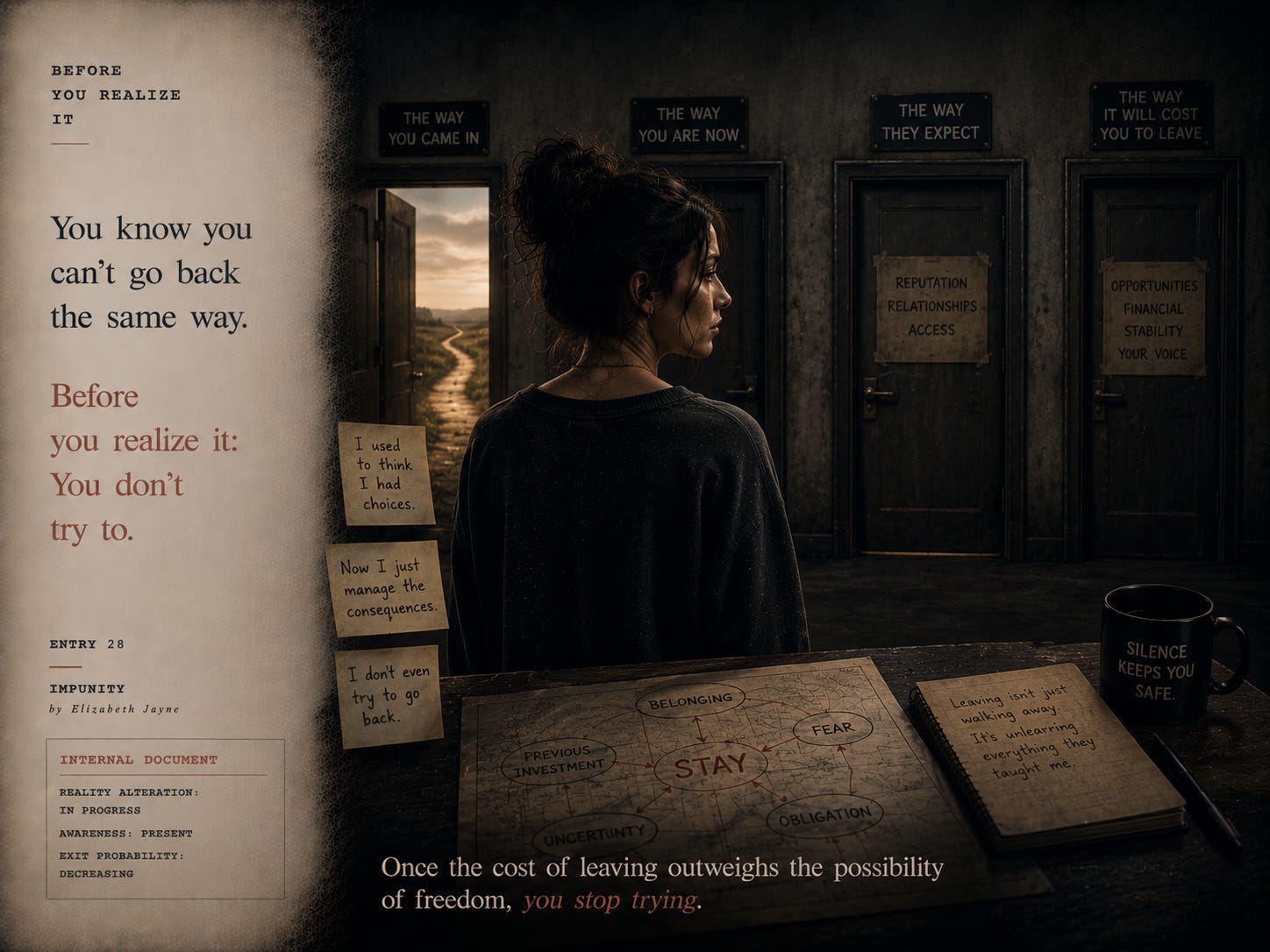
The strange thing about grooming is that people often imagine the moment of realization as the moment everything changes.
It usually isn’t.
Most of the time, the change happened much earlier. Quietly. Incrementally. Through adaptation more than force.
By the time someone fully recognizes what’s happening, they’re already calculating consequences.
Not dramatic consequences, necessarily. Smaller ones at first. Social ones. Professional ones. Emotional ones. The kind that alter behavior before anyone consciously admits they’re afraid.
You stop saying certain things.
You stop asking certain questions.
You learn which reactions create distance and which ones preserve access.
And eventually something even more unsettling happens:
You stop imagining yourself leaving the same way you entered.
I keep thinking about how often grooming changes a person’s sense of possibility before it changes anything else.
People talk about control as though it always looks physical or overt. But psychological control often works by narrowing the imaginable future. Quietly. Gradually. Until the path backward no longer feels emotionally available, even when it technically still exists.
You start thinking in terms of damage reduction instead of freedom.
How do I stay safe here?
How do I avoid becoming a problem?
How do I keep this manageable?
Institutional environments are especially good at this because they rarely frame adaptation as submission. They frame it as maturity. Professionalism. Nuance. Understanding complexity.
And human beings are remarkably willing to reinterpret their discomfort if the surrounding system rewards the reinterpretation.
Especially when there’s status attached to staying.
Especially when leaving feels like failure.
Especially when everyone around you already sounds adjusted.
Does this resonate? Leave a comment.
I read every one. Even the short ones. Especially the short ones.
That part matters more than people realize.
Normalization spreads socially long before it settles psychologically. You hear the language enough times that eventually your own thoughts begin arranging themselves around it.
After a while, the thing that once felt impossible starts feeling impractical instead.
The thing that once felt wrong starts feeling complicated.
The thing that once felt temporary starts feeling permanent.
What unsettles me is how often people mistake this adaptation for consent.
As though remaining inside something automatically means someone still believes in it.
Sometimes people remain because they no longer recognize a version of themselves that knows how to walk back toward ordinary life without carrying consequences with them.
And systems understand this better than they admit.
Not always consciously. Not always maliciously in the cartoon-villain sense people prefer because it feels easier to identify.
But institutions learn very quickly how to reward emotional accommodation.
How to make silence feel sophisticated.
How to make endurance feel intelligent.
How to make departure feel naive.
By the time someone realizes they cannot return the same way they arrived, another shift has usually already happened underneath it:
They stop trying to.
Not because they fully accept what’s happening.
Sometimes the opposite.
Sometimes because recognizing the scale of it makes the possibility of undoing it feel overwhelming.
So they adapt further instead.
People will normalize almost anything if enough emotional survival becomes attached to the normalization.